Disclaimer
All screenshots in the article were taken in the Dutch version of Nmbrs Accounting.
Which settings you can specify in a domain depends on the selected bundle (and any additional features added) and the role(s) you have as a user in the domain.
In Nmbrs Accounting, you can set the following domain settings:
- General
General information such as the owner and language of the domain, among others. - Contracts
View contract details, add or remove features to contract, cancel or reactivate contract. - Companies
All administrations included in this domain, create new administration and set up Fiscal unity if applicable. - Users
All users with access to this domain, grant or deny additional user access, delete user, assign role(s) to additional user, assign ‘Back office’ role to user if feature ‘Self-accounting’ is activated. - Messages
Which user per administration will receive messages from Nmbrs Accounting about VAT returns, points of interest, pay slips if applicable, and Peppol. - Tags
Put a “label” (tag) on specific data in the domain for easier retrieval.. - Tax authorities
Whether or not required approval of VAT return by entrepreneur before sending VAT return to tax authorities. - Block and close
Blocking and/or closing administration for audit or year-end purposes.
Tags (domain settings)
A tag acts as a digital label that can be easily applied to various items within Nmbrs Accounting. This makes these items easy to identify and find. Tags can be added to:
- Tasks
- Appointments
- Contacts
- Documents
- Projects
- E-mails.
TIP!
When WKR (Work-related costs scheme) is activated, by default you have a number of WKR tags at your disposal that you can link to transactions.
Permissions and roles
Use tags
Any user with access to the domain can view a tag's details or create a tag.
Manage tags
Only a user with the 'Backoffice' role in the domain or the 'Management' role can change a tag, merge it with another tag, or delete a tag.
Practical use of tags
A practical example of using tags is setting up a mailing list within the Nmbrs Accounting email. A specific tag, such as ‘tag1’, can be assigned per contact. While preparing an email, you can click on the search button at the recipient field and then select ‘Choose tag’. By selecting ‘tag1’, the e-mail will automatically be sent to all contacts with this tag. This way, there is no need to select each recipient individually.
It is also possible to enter the tag directly into the address field of the e-mail. This will send the e-mail directly to all contacts who have this tag.
Please note here that using a name as a tag can lead to the e-mail being sent to the mailing list instead of the intended recipient by mistake.
TIPS!
- The Bulk action feature in Contacts (CRM) allows you to tag multiple contacts at once.
- Tags can also be viewed in the Archive of a domain by adding the ‘Tags’ column.
Access to Tags (domain settings)
To access:
- click on the Settings icon in the navigation bar
then, in the now-opened screen, in the Domain section click on Tags.
Tags overview

On this screen, you can see all the details of the tags created in the domain.
AVAILABLE USER ACTIONS
From this overview, a user can:
- create a tag
- change a tag
- merge tags (in bulk)
- delete one or more tags.
Create tag
To create a new tag, click on the Create button at the top right of the screen.
The following screen is opened:

Tag
Enter the name of the tag here.
Description
Enter a clear description of the tag.
Inactive
Indicate whether the tag is currently active or inactive. An inactive tag cannot be selected and thus cannot be added to digital items.
Then click on the Create button.
Change tag
To change a tag:
- hover the mouse over the line of that tag
- click on the button with the three dots
- then select the Edit menu option from the dropdown menu.

The following screen is opened:
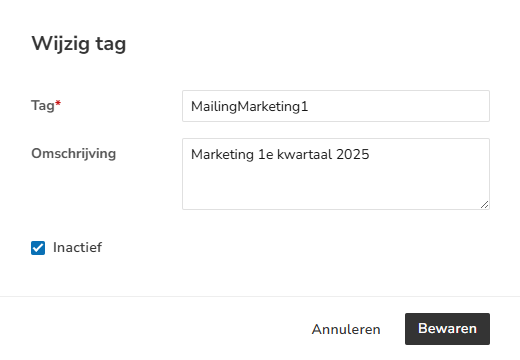
Change the tag name or description or indicate that the tag should be deactivated, then click on the Save button.
Merge tags (in bulk)
To merge tags in bulk:
- hover over the line of the corresponding tag
- clcik on the button with the three dots
- then select the Merge tag with... menu option from the dropdown menu.

The following screen is opened:

Select the tag that particular tag should be merged with, then click on the Merge button.
The following message will appear on your screen:

TIP!
It is also possible to merge multiple tags in bulk.
Select the tags you want to merge and then click on Merge at the top of the screen.

Delete one or more tags
To delete one tag:
- hover over the line of that tag
- click on the button with the three dots
- then select the Delete menu option from the dropdown menu.

The following screen is opened:

Click on the Delete button to actually remove the tag.
The following message will appear on your screen:

TIP!
It is also possible to delete multiple tags in bulk.
Select the tags you want to delete and then click on Delete at the top of the screen.
Was this article helpful?
That’s Great!
Thank you for your feedback
Sorry! We couldn't be helpful
Thank you for your feedback
Feedback sent
We appreciate your effort and will try to fix the article