Disclaimer
All screenshots in the article were taken in the Dutch version of Nmbrs Accounting.
Before you can immediately view your administration as an entrepreneur, you will go through a short start-up phase together with your accountant. In this article, you will find the key pillars for getting off to a flying start.
- Start-up phase with your accountant
- Log in and navigate within domain
- Customize settings
- Submit your administration.
1. Start-up phase with your accountant
Before you actually begin, a number of basic details must be entered by both yourself and your administration office or accountant.
For a detailed description of all the steps you go through with your accountant to set up your administration, see the article Start with new domain (entrepreneur).
2. Log in and navigate within domain
As soon as your login details are active, you can log in to your own online environment (the 'domain').
For a detailed description, see the article Log in to your domain in Nmbrs Accounting
You can navigate within your domain to make use of various functionalities/features.
For a detailed description, see the article Navigate within domain in Nmbrs Accounting
3. Customize settings
You can fully customize Nmbrs Accounting by changing personal preferences and general domain settings.
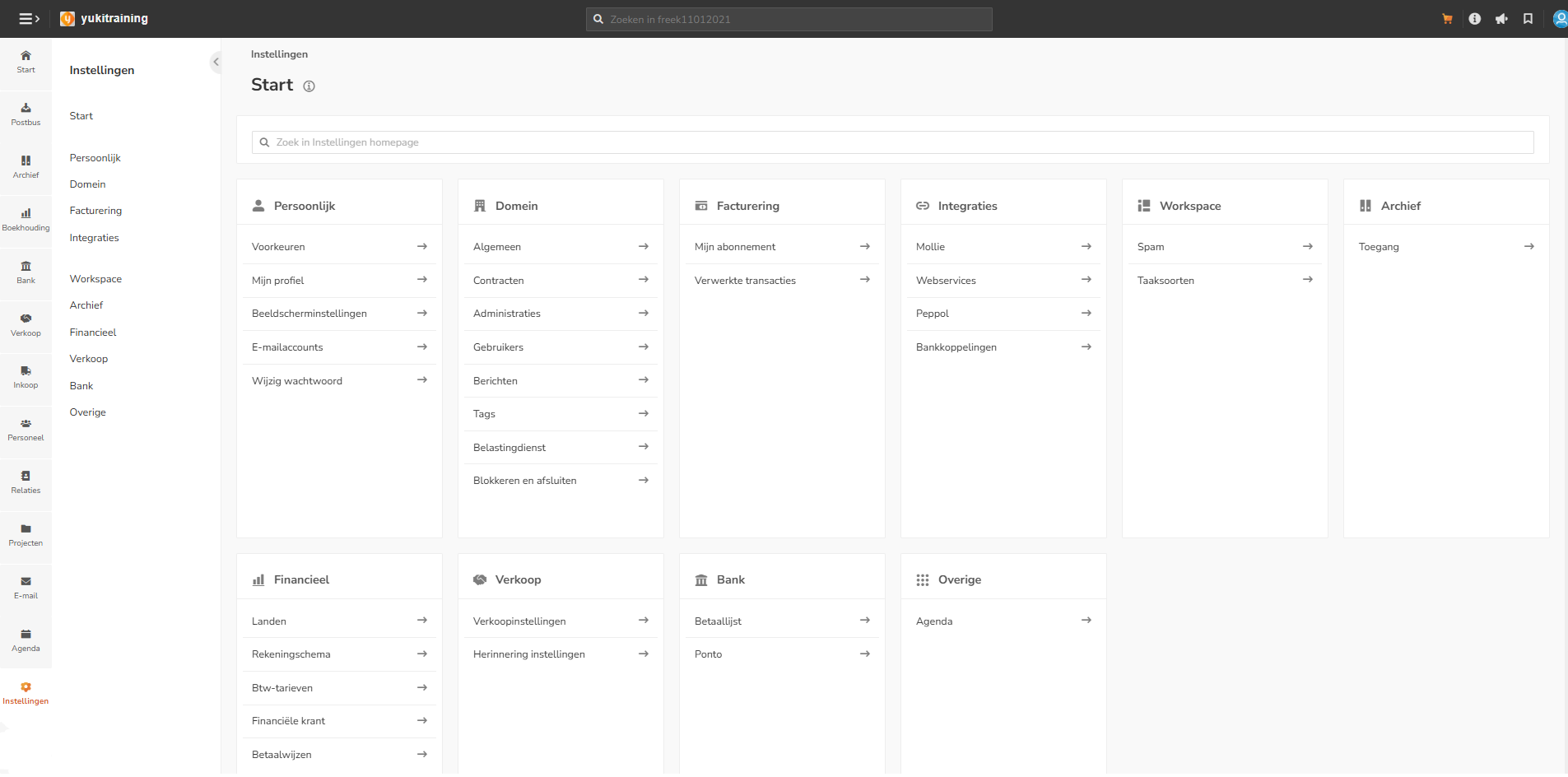
Permissions
Exactly which settings and functions you see depends on the permissions (user role) you have within the domain and the extra features that have been activated for your domain.
For a detailed description, see article Settings.
4. Submit your administration
Up-to-date bookkeeping depends on submitting your documents (purchase invoices, sales invoices, receipts) and bank transactions on time. In Nmbrs Accounting, this can be done in five different ways:
- Upload: drag and drop files directly from your computer.
- Email: forward documents directly to the unique email address of your Nmbrs Accounting domain.
- Nmbrs Accounting app: quickly take a photo of your receipt or invoice with your smartphone (available for iOS and Android).
- Dropbox: automatically synchronize documents via your own Dropbox account.
- Google Drive: automatically synchronize documents via your own Google Drive account.
How does it work?
Open the PO Box in Nmbrs Accounting and choose the submission method that is most convenient for you at that moment.

For a detailed description by submission method, see article Scan, upload, synchronize and/or email.
Was this article helpful?
That’s Great!
Thank you for your feedback
Sorry! We couldn't be helpful
Thank you for your feedback
Feedback sent
We appreciate your effort and will try to fix the article