An MT940 file (where MT stands for Message Type) or (SWIFT) MT940 is an international standard format for exporting financial bank transactions. This type of file is also known as the Customer Statement Message and follows a specific, structured format.
Although there is a global international standard for the structure of an MT940 file, the exact implementation and detailed specifications may vary by bank.
Why is MT940 used?
Most banks offer the option to export transaction history via online banking as an MT940 file. Nmbrs Accounting and other accounting software can then import this file as an electronic bank statement. This allows all bank transactions to be processed quickly and accurately in one go, without having to manually retype transactions.
Format and structure of MT940
Technically speaking, an MT940 file is a plain text file (.txt) composed of multiple lines of text. Together, these lines form the various transaction records.
The following fixed rules apply when constructing an MT940 file:
- Fixed tags: Each specific record type (such as the opening balance, the transaction, or the description) is preceded by a fixed tag in the form of :XX: (for example, :61: or :86:).
- Multiple messages: A single export file can contain one or more consecutive bank messages.
- One account per message: Each individual message within the file always refers to exactly one specific bank account number.
Transaction lines: Multiple transaction records (:61:) and associated description records (:86:) can be combined within a single message.
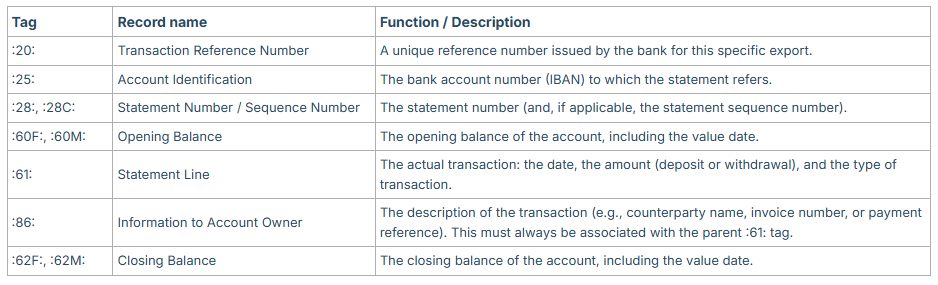
Overview of most important MT940 records
Below is the structure of the most common tags (records) within an MT940 message:
Was this article helpful?
That’s Great!
Thank you for your feedback
Sorry! We couldn't be helpful
Thank you for your feedback
Feedback sent
We appreciate your effort and will try to fix the article