Disclaimer
All screenshots in the article were taken in the Dutch version of Yuki.
For a contact in a domain, you can set two types of automation rules (read: processing rules) to enhance the automatic processing of purchase invoices, sales invoices, and/or Yuki sales invoices (sales invoices generated using the Sales functionality): default values and UBL rules.
The default values are crucial settings for fully automated document processing!
These values can be entered per company.
Default values
- Purpose: These are set at the supplier or customer level to facilitate automatic data entry during invoice processing.
- How it works: When a purchase or sales invoice from a specific supplier or customer arrives, predefined values are automatically filled in, such as GL accounts and other relevant data.
UBL rules (only for UBL/PDF and UBL invoices)
- Purpose: These rules are specific to purchase or sales invoices submitted in UBL format.
- How it works: They allow you to post invoice lines to different general ledger accounts at the line level, allowing for more detailed and flexible processing.
ATTENTION!
Before you can split at the line level using UBL rules, a default value must first exist.
A number of default values from a single supplier or customer together form a document processing rule. It is also possible to create multiple default values (processing rules) at the document and line level.
Only a user with the 'Back office' role in the domain or the 'External accountant' role can view and create default values (local processing rules) in a domain.
From the standard values and UBL rules overview, a user can:
- create a default value or UBL rule
- change the payment method of one or more default values
- change a default value or UBL rule
- delete one or more default values or UBL rules
- view the contact.
Access to Default values
To access them:
- hover your mouse over the Contacts icon in the navigation bar
- then click on Deafult values.
Default values and UBL rules overview
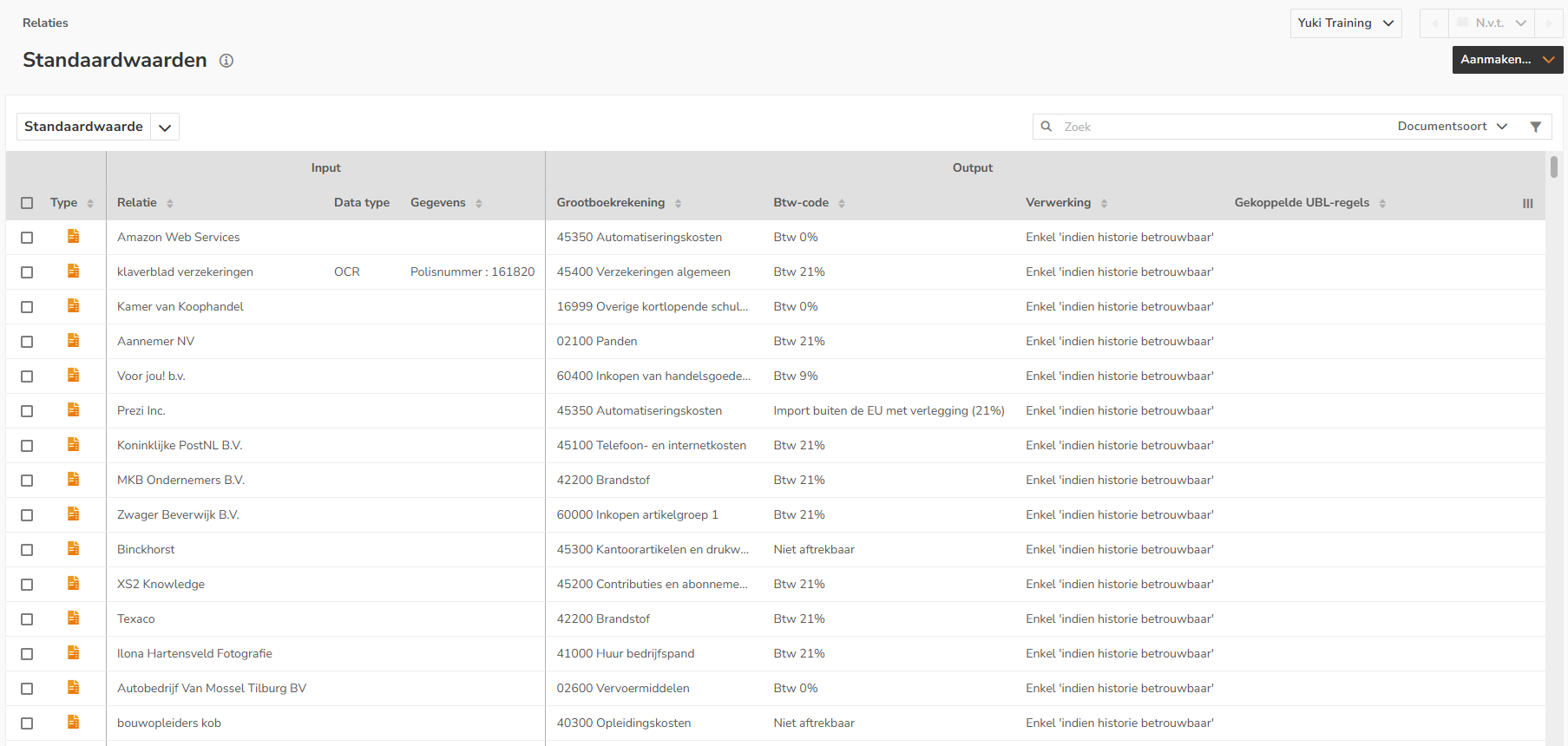
The screen showing all created default values and UBL rules in the domain always opens in the Default value view.
A check mark appears in the Linked UBL rules column when one or more UBL rules have been created for the default value in question.
Views
You can also specify in this screen whether the UBL rule view should be shown:
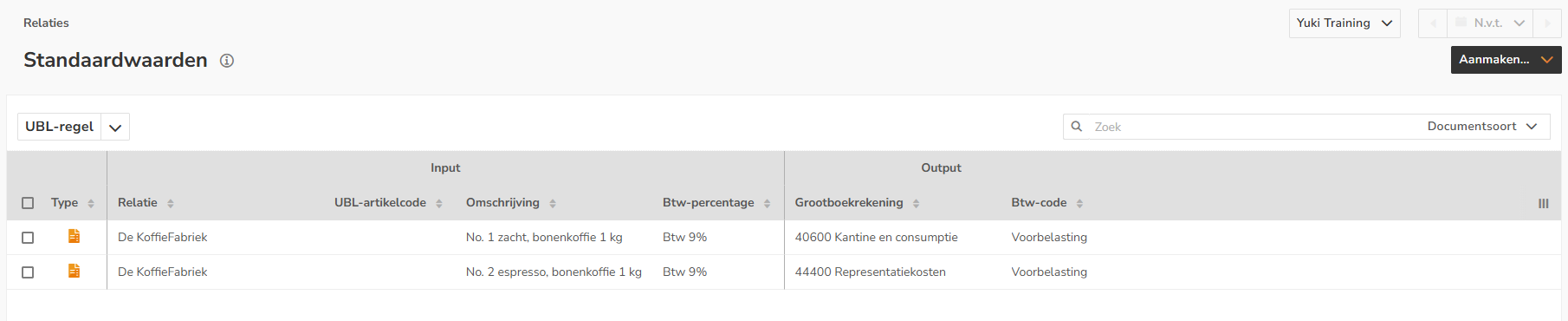
Filters
In both views, you can filter the shown data by Document type:
- Purchase Invoice
- Sales Invoice
- Yuki Sales Invoice.
In addition, in the 'Default value' view, you can use an advanced filter by clicking on the filter button in the top right corner of the search bar/filter bar:

This allows you to filter the displayed data by:
- Payment method:
- Electronic transfer
- Direct debit
- Cash
- Debit card
- Credit card
- Will be refunded
- Received cash
- To be offset
- Private payment
- Received in private
- iDEAL
- Online
- Mollie
- Any custom payment methods.
- Processing:
- Always: Automatically process the document when all required fields on the invoice have been recognized.
- Reliable history: Automatically process the document when 50% of the invoices from this supplier in the past 18 months have been recognized correctly.
- Never: Yuki will recognize the invoice as usual, but it must still be manually processed from the workflow for verification.
- Data type:
- OCR
- XML.
ATTENTION!
If you select more than one filter in the advanced filter, they will be applied as AND-AND criteria.
You can search for a default value by Contact in the Search field.
Create default value or UBL rule
To create a default value or UBL rule, click on the Create button and then select the Default value or UBL rule menu option.
For a detailed description, see articles Create default value (local processing rule) in domain and Create UBL rule (local processing rule) in domain.
Change payment method of default value
Select the default values for which you want to change the payment method. Then click on Change payment method at the top of the screen.
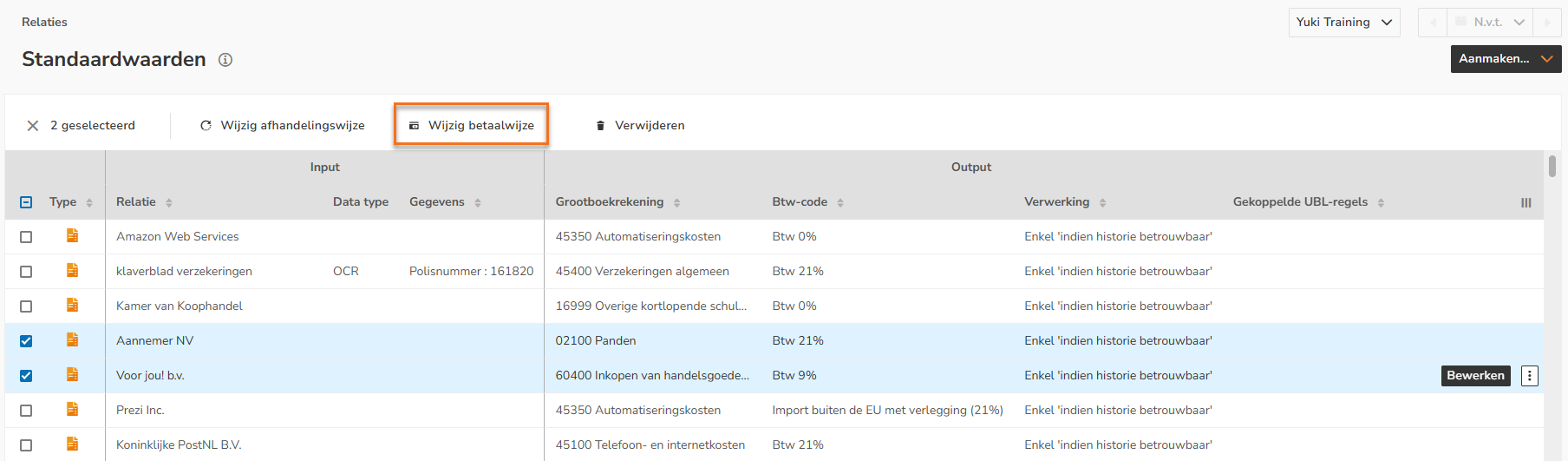
The following screen is opened:
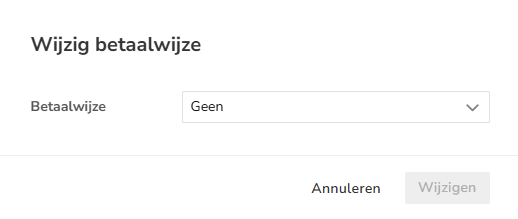
Select the correct payment method for the default values and then click on the Edit button.
The payment method for all selected default values has now been changed.
Change default value or UBL rule
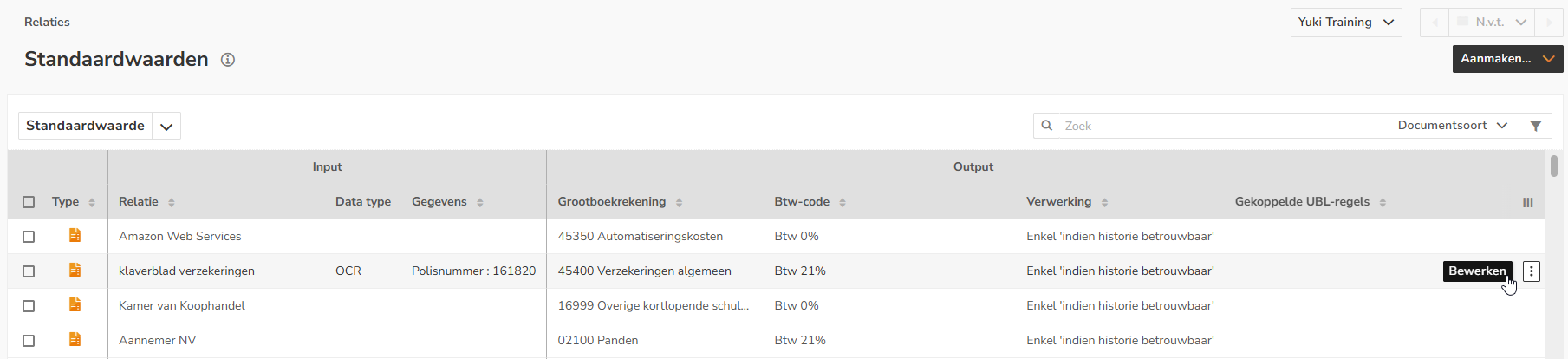
To change a default value or UBL rule, hover your mouse over the line for the relevant default value or UBL rule and then click on the Edit button.
The folllowing screen is opened:
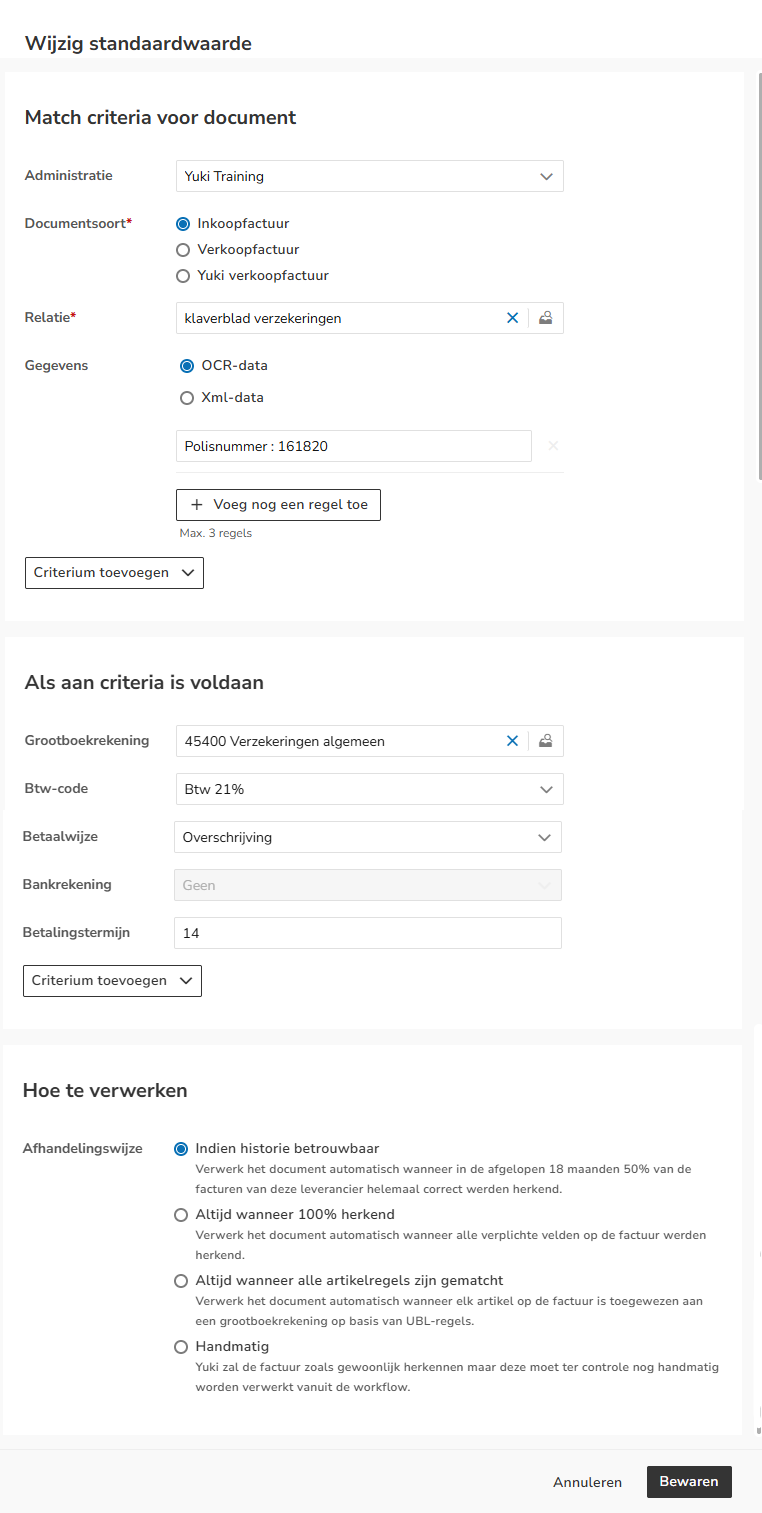
Edit the Input criteria (under Match criteria for document) and/or Output criteria (under When criteria are met) details.
Then click on the Save button.
TIP!
- Click on the Add property button under Match criteria for documentto use more Input criteria:
- Amount: invoice amount from to a certain amount
- Priority: which default value (document processing rule) has the highest priority?
- Date: date from (start date) to a certain date (due date)
- Data (OCR/XML): part of the OCR or XML text of a document
The maximum of three added OCR or XML text fields are applied as AND-AND criteria.
- Click on the Add property button under When criteria are metto use more so-called Output criteria:
- Payment method: how the purchase or sales invoice must be paid
- Payment term: the number of days within which an invoice must be paid
- Payment discount: a discount (in percentage) on the invoice amount
- Subject template: the invoice subject according to a template (with placeholders)
- Currency: the currency of the invoice amount (selection from all currencies active within the domain)
- Project: the project that will be linked to the invoice.
Delete default values or UBL rules
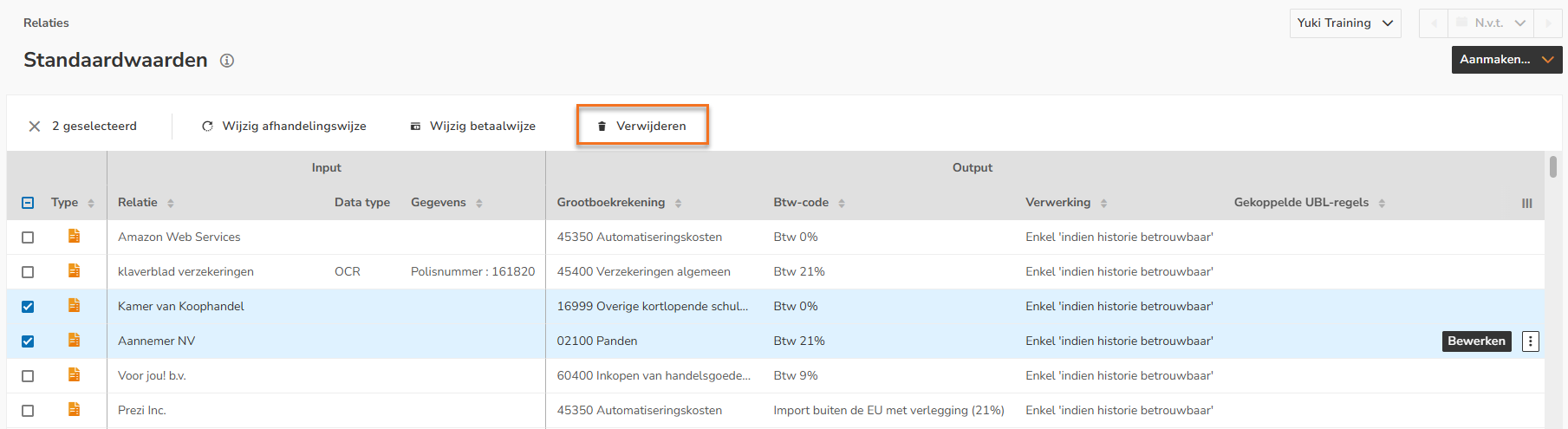
Select the default values or UBL rules you want to delete. Then click on Delete at the top of the screen.
The following screen is opened:
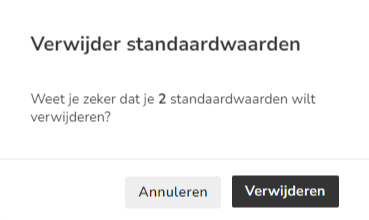
The selected default values or UBL rules will be deleted.
TIP!
To delete a single default value or UBL rule:
- hover your mouse over the line containing the relevant default value or UBL rulec
- click on the button with the three dots
- then select Delete from the dropdown menu.
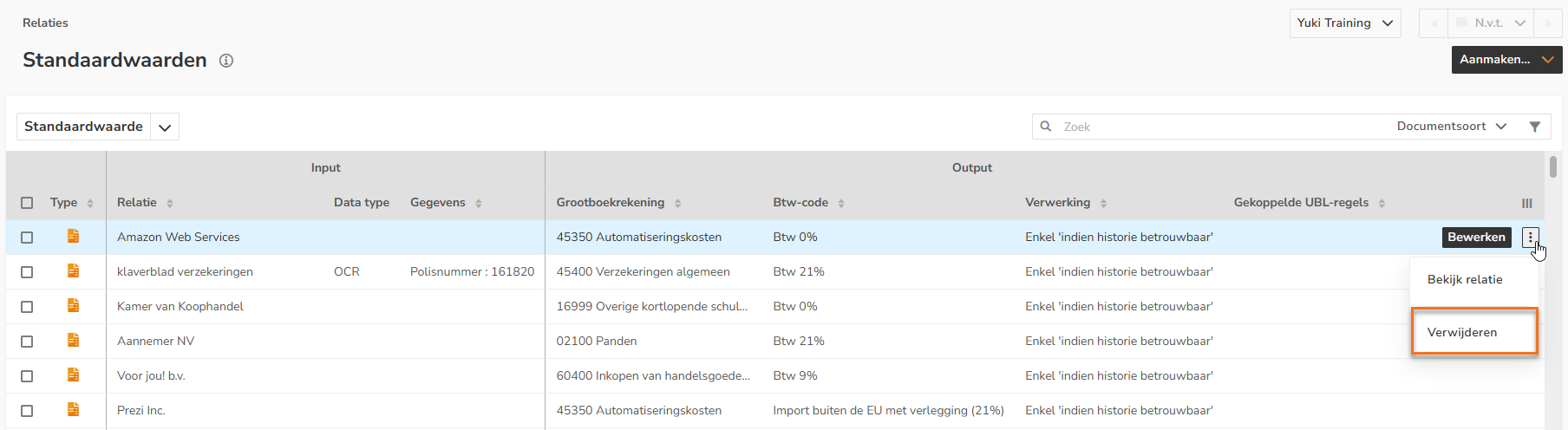
The folllowing screen is opened:
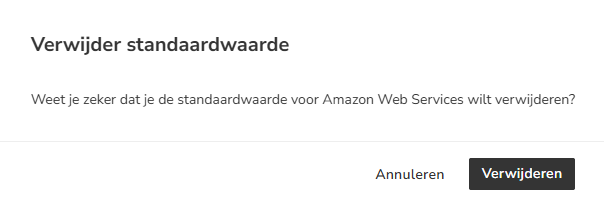
Then click on the Delete button to actually delete the default value or UBL rule.
View contact
To view the contact:
- hover your mouse over the line for the contact in question
- click on the button with the three dots
- then select View contact from the dropdown menu.
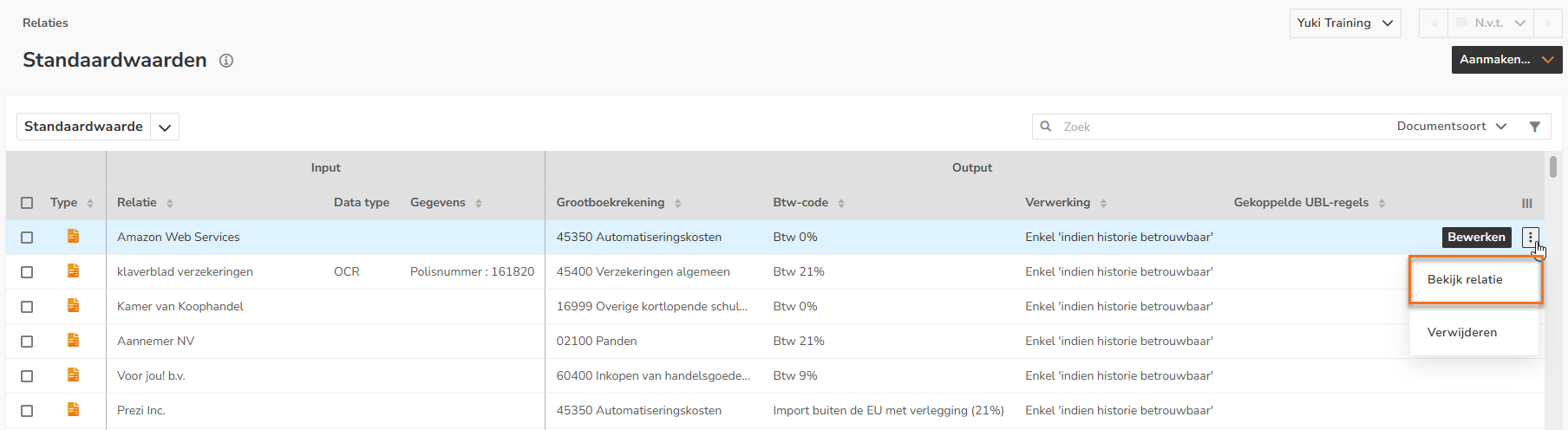
The contact card for the relevant contact is now opened.
TIP!
You can also view the default values for a supplier or customer by opening the relevant contact card and clicking on Default values.
Was this article helpful?
That’s Great!
Thank you for your feedback
Sorry! We couldn't be helpful
Thank you for your feedback
Feedback sent
We appreciate your effort and will try to fix the article