Disclaimer
All screenshots in the article were taken in the Dutch version of Nmbrs Accounting.
In Nmbrs Accounting, it is possible to manually create a sales invoice and then send it to your customer by mail, email or via Peppol. Then, if necessary, the invoice can be handled correctly.
To create a new sales invoice, the following steps must be followed:
enter the invoice details (contact. layout, payment term and method)
if necessary, add additional details (e.g. when paying an invoice via 'Direct debit' or 'Refund')
- if required, add an attachment to the invoice (from your device or from the Archive in Nmbrs Accounting)
- save the invoice as a draft invoice.
Access to new sales invoice
You can create a sales invoice from three places in Nmbrs Accounting:
- click on the Sales icon in the navigation bar
- if required, click on Dashboard
- then, if required. select the Invoice menu option from the dropdown menu of the Create... button
OR - click on the Sales icon in the navigation bar
- click on Invoices
- then, in the now-opened screen, click on the New Invoice button.
OR - click on the Contacts icon in the navigation bar
- in the now-opened screen, open the relevant contact card
- then, in the now-opened screen, click on the Sales Invoice button.
Add additional details
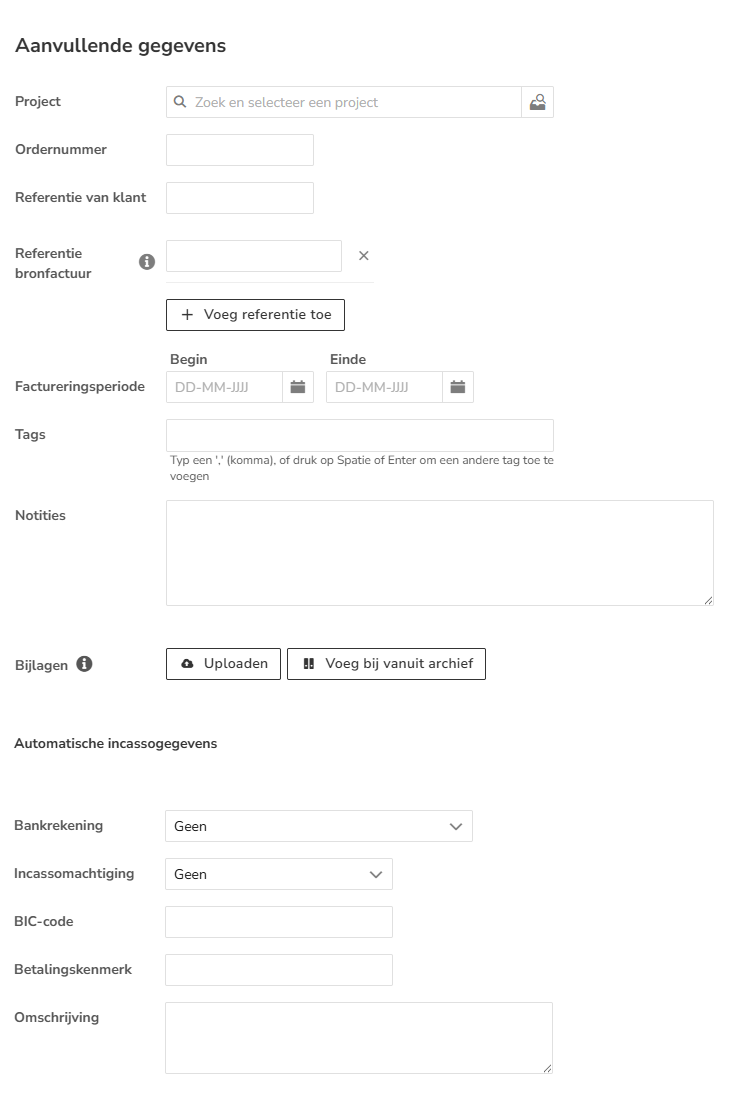
Additional data can be added in the fields described below, if necessary.
Project
Select the project to which this sales invoice should be added.
This field is only available when a user with the 'Management' role has selected the Medium, Large or Unlimited bundle via the Store in the domain.
Order number
It is possible to include a PO/order number on the sales invoice. This number will automatically be included on the UBL invoice as well.
ATTENTION!
If no order number is entered, the 'Order number' field will not appear on the sales invoice.
Buyer reference
A buyer reference such as the name of a department or an internal code can be added to the sales invoice. This reference will be included in the XML of the UBL invoice.
ATTENTION!
If no order number or buyer reference is entered, the customer's Chamber of Commerce number will be included in the XML of the UBL invoice. If the customer's Chamber of Commerce number is not present, the invoice number will be added in the XML of the UBL invoice.
Source invoice reference
This field can be used for informational purposes to reference a previously issued sales invoice.
For a credit invoice, it is advisable to include the original invoice number to which the credit invoice refers.
To add up to three references to a source invoice, click on the Add reference button.
Invoicing period
The start and end dates of the invoice period of the invoice. This period is included in the XML of the UBL invoice.
Tags
If you specify a tag for the sales invoices you create in Nmbrs Accounting, you can easily find these invoices with the same tag.
Create a new tag by entering the tag name. After entering, click outside the field so that a new empty field is automatically opened for entering a second new tag, etc.
Direct debit details
Bank account
The default bank account is automatically filled in if it has been specified for the contact (customer).
If multiple bank accounts have been specified for the contact, you can also select a different bank account here.
Mandate reference
The reference number of the direct debit mandate.
The direct debit mandate is filled in automatically if it has already been created for the customer's bank account.
BIC code
This code is automatically filled in by Nmbrs Accounting (required for payments from abroad).
Structured payment ID
The invoice number of the invoice to be collected.
Description
The description of the collection order.
Was this article helpful?
That’s Great!
Thank you for your feedback
Sorry! We couldn't be helpful
Thank you for your feedback
Feedback sent
We appreciate your effort and will try to fix the article