Disclaimer
All screenshots in the article were taken in the Dutch version of Nmbrs Accounting.
In Nmbrs Accounting, you can create a contract to set up recurring invoices for a customer and send them automatically if required.
To create a new contract, complete the following steps:
- enter contract details (contact and contract details)
- enter invoice details (invoice information) of contract
- add one or more invoice lines (items) to contract
- if necessary, add additional information to contract
- if necessary, add payment details to contract (e.g. when paying an invoice via 'Direct debit' or 'Refund')
- if required, add an attachment to the contract (from your device or from the Archive in Nmbrs Accounting)
- if necessary, add notes to contract
- change, if necessary, sending method of recurirng invoice and/or customer email address
- save contract as a draft contract or a completed contract.
Access to new contract
You can create a contract from three places in Nmbrs Accounting:
- click on the Sales icon in the navigation bar
- click on Dashboard
- then, in the now-opened screen, click on the Create contract button.
OR - click on the Sales icon in the navigation bar
- click on Contracts
- then, in the now-opened screen, click on the Create contract button.
OR - click on the Contacts icon in the navigation bar
- click on Contacts
- open the relevant contact card
- in the now-opened screen, click on Sales invoices
- open a sales invoice created by Nmbrs Accounting
- Then click on the Generate contract button.
Invoice details of contract
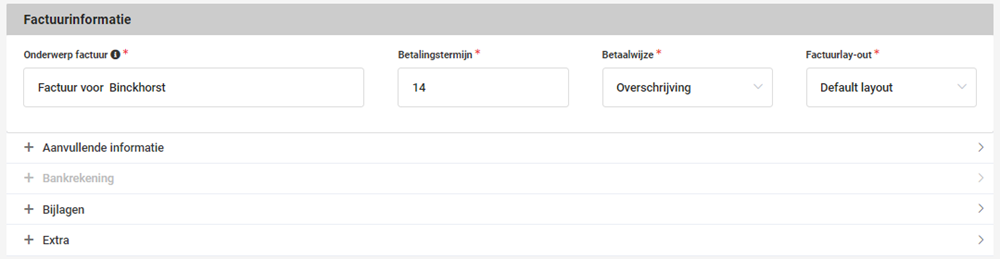
The following describes which invoice details (invoice information) need to be entered or changed.
Invoice subject (required)
After selecting the customer, Nmbrs Accounting automatically fills in the subject "Invoice for [contact]". This can be changed manually.
A so-called placeholder (dynamic period) can be added to the subject of the invoice:
- [Period] Name of the period for which the invoice is generated
- [PeriodNumber] Number of the period for which the invoice is generated
- [Year] Year for which the invoice is generated.

The value of the placeholder (previous period, current period or upcoming period) will be automatically taken from the value selected in the invoice at ‘Invoicing period’.
When ‘Default’ is selected at the invoicing period, the value of the placeholder will be automatically taken from the contract settings (at Sales settings).
Even after processing and/or sending the recurring sales invoice, the subject of the invoice can still be changed.
Payment term (required)
The payment term in days is inherited from the invoice settings (in the Sales settings).
However, the number of days can be changed manually here. When sending the recurring invoice, the correct due date is automatically calculated based on the invoice date.
Payment method (required)
The default payment method of a recurring invoice is by default ‘Electronic transfer’. However, the payment method can be manually changed here to:
- Direct debit (add payment details)
- Cash
- Debit card
- Credit card
- Will be refunded
- Received cash (cash from business account)
- To be offset
- Private payment
- Received in private (cash, debit card or credit card from private bank account)
- iDEAL
- Online (online payment provider such as PayPal, Pay.nl or MultiSafepay)
- Mollie.
ATTENTION!
Sales invoices recorded with payment type ‘Debit card’, ‘Credit card’, ‘iDEAL’ or ‘Online’ do not appear in the outstanding debtors but are posted on ‘23300 Suspense account debit card payments’, ‘23310 Suspense account credit card payments’, ‘23320 Suspense account iDEAL payments’ or ‘23330 Suspense account online payments’ respectively.
Invoice layout (required)
The invoice layout is taken from the contract settings (in the ‘Sales settings’).
However, if a customer-specific invoice layout is present on the customer's contact card, it will be filled in automatically. However, the invoice layout can be changed manually here.
TIP!
To create an English, French or German recurring sales invoice select an English, French or German invoice layout here.
Was this article helpful?
That’s Great!
Thank you for your feedback
Sorry! We couldn't be helpful
Thank you for your feedback
Feedback sent
We appreciate your effort and will try to fix the article