This article describes the functional implementation in the software of several fields in the purchase invoice XML. This XML must be submitted using the web service method `Purchase - ProcessPurchaseInvoices(sessionID, administrationId, xmlDoc)`.
ATTENTION!
We recommend reviewing the XML schema below; this information is the most comprehensive and is provided in English.
Web address of the XML schema for purchase invoices
http://www.yukiworks.nl/schemas/PurchaseInvoices.xsd
Field descriptions
Below is a description of the fields. The XML schema itself also contains a description of the fields and specifies the expected values and data types.
PurchaseInvoice: Process
Use this field to indicate whether you want to process the invoice immediately. If you choose to process the invoice, you must also enter the correct invoice number in the “Reference” field.
If the value is “True,” the invoice is processed in Nmbrs Accounting without approval. If the value is “False,” the invoice is not processed in the accounting system and must be processed manually by the accountant.
If the TAG Process is missing, Nmbrs Accounting assumes the value is “false.”
PurchaseInvoice: Reference
You can enter the invoice number in this field.
The invoice is processed, printed, and/or sent outside of Nmbrs Accounting. Therefore, the invoice has been assigned an invoice number outside of Nmbrs Accounting.
PurchaseInvoice: Date
The invoice date.
PurchaseInvoice: DueDate
The due date.
PurchaseInvoice: InvoiceAmount (required)
This decimal field sets the total invoice amount.
PurchaseInvoice: InvoiceVATAmount (required)
This decimal field specifies the total VAT amount on the invoice.
PurchaseInvoice: Currency
The currency of the purchase invoice. If the field is left blank, the default value is ‘EUR’.
PurchaseInvoice: PaymentMethod
The payment method for the invoice. Possible options:
- Unspecified (In Nmbrs Accounting, 'Electronic transfer” is then entered as the payment method for the invoice)
- ElectronicTransfer (electronic transfer)
- DirectCollection
- Cash
- DebitCard (pinbetaling)
- CreditCard
- ReceivedElectronically
- ReceivedCash
- ToSettle
PurchaseInvoice: PaymentReference
Dit string-veld stelt de non structured payment reference van de factuur in.
PurchaseInvoice: PaymentID
Dit string-veld stelt de structured payment ID van de factuur in.
PurchaseInvoice: ProjectID
De ID van het project waaraan je het document wilt koppelen. Het meegeven van deze parameter maakt de parameter 'ProjectCode' overbodig.
Een gebruiker met de rol 'Directie' dient wel de bundel Medium, Large of Unlimited te hebben gekozen via de Store in het domein.
PurchaseInvoice: ProjectCode
De code van het project waaraan je het document wilt koppelen. Deze parameter wordt alleen gebruikt als de parameter 'ProjectID' niet wordt meegegeven.
Een gebruiker met de rol 'Directie' dient wel de bundel Medium, Large of Unlimited te hebben gekozen via de Store in het domein.
Purchaseinvoice: Remarks
De ingegeven informatie komt niet op de factuur maar wordt als notitie bij de inkoopfactuur opgeslagen.
PurchaseInvoice: DocumentFileName (verplicht)
De naam van het bestand met de extensie .pdf.
PurchaseInvoice: DocumentBase64 (verplicht)
Dit veld moet de pdf bevatten als een Base64 string. Nmbrs Accounting zal de Base64 string visualiseren in het eigenlijke PDF document.
Contact: Contact
In het Contact element wordt de relatie/leverancier van een factuur opgegeven. Er zal eerst naar een bestaande relatie in het adresboek van Nmbrs Accounting gezocht worden. Er wordt gezocht:
- Indien een relatiecode is opgegeven: op relatiecode via het veld 'ContactCode'
- Indien niet gevonden of geen relatiecode opgegeven: op volledige naam via het veld 'FullName'
Indien geen bestaande relatie wordt gevonden wordt een nieuwe relatie aangemaakt.
Contact: gevonden bij ContactCode (= relatiecode op de relatiekaart)
- Als een relatiecode wordt gebruikt worden de adresgegevens van een bestaande relatie altijd overschreven met de huidige waarde in het XML-bronbestand.
- Om een veld niet te overschrijven kan het element volledig worden weggelaten uit het XML-bronbestand.
TIP!
Als je leverancier-ID's of leverancierscodes gebruikt in jouw toepassing, stuur deze dan ook mee in de XML. Zo heb je in beide applicaties altijd een één-op-één match tussen de leverancier en de factuur.
Contact: gevonden met FullName (= naam of bedrijfsnaam op de relatiekaart)
- Als een relatie met dezelfde naam wordt gevonden worden alleen de lege velden van die relatie aangevuld met gegevens uit het XML-bronbestand.
- Voor de adresgegevens geldt ook dat alleen gegevens worden aangevuld als de bestaande gegevens overeenkomen.
Bijvoorbeeld het adres 'Dorpstraat 40, Ons Dorp' zal worden aangevuld tot 'Dorpstraat 40, 1234 XX, Ons Dorp' indien in de XML het adres en woonplaats hetzelfde zijn en ook de postcode is opgegeven.
Contact: EmailAddress
Het is mogelijk om één e-mailadres mee te geven. Dit adres wordt bij de relatiekaart van de leverancier opgeslagen.
Contact: ContactType
Je kunt definiëren of een leverancier een particulier of een bedrijf is.
Contact: BankAccount (verplicht)
Indien een rekeningnummer wordt opgegeven wordt deze als bankrekening van de leverancier opgeslagen. Het rekeningnummer wordt ook gebruikt als rekeningnummer voor deze factuur. Het is dus mogelijk om meerdere rekeningnummers voor dezelfde leverancier aan te leggen.
LET OP!
Het bankrekeningnummer is een verplicht veld voor een inkoopfactuur.
Contact: BIC
Indien een BIC code wordt opgegeven wordt deze als BIC code bij de bankrekening van de leverancier opgeslagen. Het rekeningnummer met BIC code wordt ook gebruikt als rekeningnummer voor deze factuur.
LET OP!
Hierdoor is het dus mogelijk om ook buitenlandse bankrekeningen aan te maken.
InvoiceLine: Description
De omschrijving van de factuurregel. Als dit veld leeg of niet aanwezig is wordt de omschrijving uit 'Product Description' gebruikt.
InvoiceLine: GLAccountCode
Dit stringveld bepaalt de code van de grootboekrekening in Nmbrs Accounting. Een standaard grootboekrekening wordt gekozen door de webservice als dit veld leeg wordt gelaten of een niet bestaande code van een grootboekrekening bevat.
InvoiceLine: LineAmount (verplicht)
Dit decimale veld stelt het bedrag van de factuurregel in. Dit bedrag is exclusief BTW.
Dit is een verplicht veld.
InvoiceLine: LineVATPercentage
Dit decimale veld stelt het btw-percentage van de factuurregel in.
LET OP!
Het wordt niet aangeraden dit veld te gebruiken. Er wordt namelijk afgeweken van de Nmbrs Accounting rekenmethodes!
Gebruik liever de automatische berekening op basis van het veld "InvoiceAmount".
Dit veld is alleen nuttig als er verschillende btw-percentages worden gebruikt in een factuur.
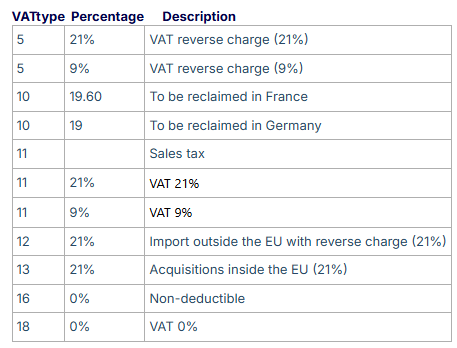
Invoiceline: LineVATType (verplicht)
Dit integer-veld bepaalt welke btw-code moet worden gebruikt.
Invoiceline: LineVATDescription
Dit string-veld bepaalt welke btw-code moet worden gebruikt. De beschrijving van de btw-code is in het domein te vinden via de domeininstellingen bij 'Btw-tarieven instellen'.
Invoiceline: VATDeductibilityPercentage
Dit integer veld bepaalt het aftrekbaarheidspercentage van "InvoiceVATAmount". Als dit veld leeg wordt gelaten, wordt de standaardwaarde binnen Nmbrs Accounting gebruikt.
Was this article helpful?
That’s Great!
Thank you for your feedback
Sorry! We couldn't be helpful
Thank you for your feedback
Feedback sent
We appreciate your effort and will try to fix the article